
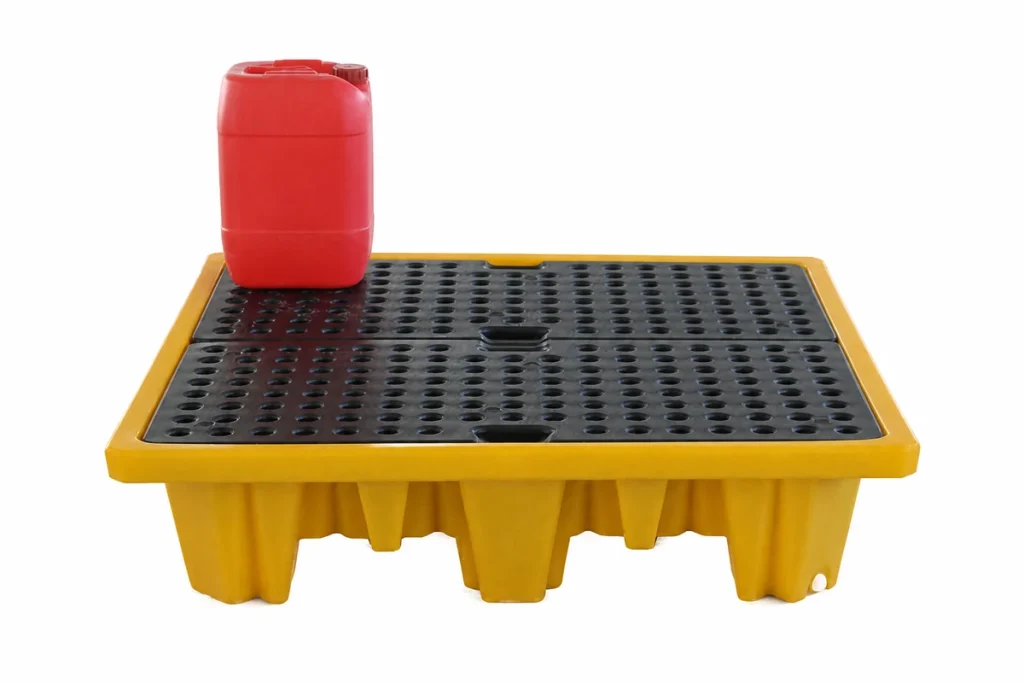
Plastic and steel spill pallets can both support drum storage, but they are not interchangeable in every workplace. The right choice depends on the stored liquid, the operating environment, handling requirements and the documentation supplied for the exact model. A buyer should compare those conditions before focusing on price or appearance.
Start with the liquid and the working environment
Material compatibility comes first. Give the supplier the liquid name, concentration, expected contact time and storage conditions. Do not assume that every plastic or steel model suits every chemical. Ask for compatibility information for the exact pallet material, grate and drain components.
The surrounding environment also matters. Indoor drum storage, outdoor yards, washdown areas and process zones expose equipment to different moisture, temperature and handling conditions. If the pallet may sit outdoors, confirm how the complete model should be used and maintained. If heat, hot work or a fire-sensitive process is involved, include that information in the review rather than relying on a general material comparison.
Compare corrosion and surface condition
Steel equipment may need a coating or another form of surface protection, depending on the model and its intended use. Buyers should check how that surface responds to scratches, moisture and the stored liquid. Inspection and repair procedures should also be clear.
Plastic spill pallets do not use a painted steel surface, but this does not remove the need for inspection. Check the pallet body, removable grate, drain area and any fittings for damage or contamination. The supplier should confirm the material used in each component when compatibility is important.
Check handling before choosing a material
A spill pallet is part of a handling system, not just a tray under a drum. Confirm whether the selected model can be moved, how it should be moved and whether drums must be removed first. Fork openings, pallet dimensions and the condition of the load all affect handling.
Do not copy a load rating from a similar-looking model. Ask for the exact static load, handling instructions and any restrictions for the selected product. The same rule applies to steel units. Construction details and support points vary between models.
Measure containment needs for the actual project
Drum count alone does not define a suitable spill pallet. Buyers need the drum size, total stored volume, site rules and any required allowance for rain or process liquids. Regulations and company standards differ by location and application, so a universal capacity statement is not reliable.
Compare the documented sump capacity of the exact model with the requirement set for the site. Also check whether the working arrangement leaves enough space to place and remove drums safely. A model designed for two drums may have a different footprint, deck height and handling method from a four-drum model.
Cleaning and inspection should fit the operation
Ask how the grate is removed, how the sump is inspected and how collected liquid should be handled. A drain can simplify some maintenance procedures, but its use depends on site rules and the liquid involved. Confirm whether the drain is included, optional or not available on the selected model.
Steel and plastic units may require different cleaning products and inspection routines. The practical question is whether staff can inspect the sump, clean the contact surfaces and return the unit to service without damaging it.
Compare lifetime cost alongside purchase price
Purchase price is only one part of the decision. Include delivery, movement, cleaning, inspection, repair and replacement in the comparison. Weight may affect manual positioning and transport, while the chosen construction may affect how damage is assessed or repaired.
Service life cannot be predicted from material name alone. It depends on the liquid, exposure, handling and maintenance. Ask the supplier what evidence is available for the proposed model and record the operating conditions used for the recommendation.
Information to send with an enquiry
A useful quotation request should include:
- the liquid name and concentration;
- drum size and number of drums;
- indoor or outdoor use;
- required containment capacity or applicable site rule;
- planned handling method;
- cleaning and drain requirements;
- available floor space and any height limit.
This information allows a supplier to compare a plastic model with any steel alternative on the same operating basis.
Where to compare Zhenghao spill containment products
Browse the drum spill pallet range to review available plastic models. For a broader selection process, read what buyers should confirm before ordering a drum spill pallet. Exact dimensions, loads, sump capacity, material and options remain model-specific.
If you have the drum details and site requirements ready, send Zhenghao your project information for a model-specific review and quotation.