
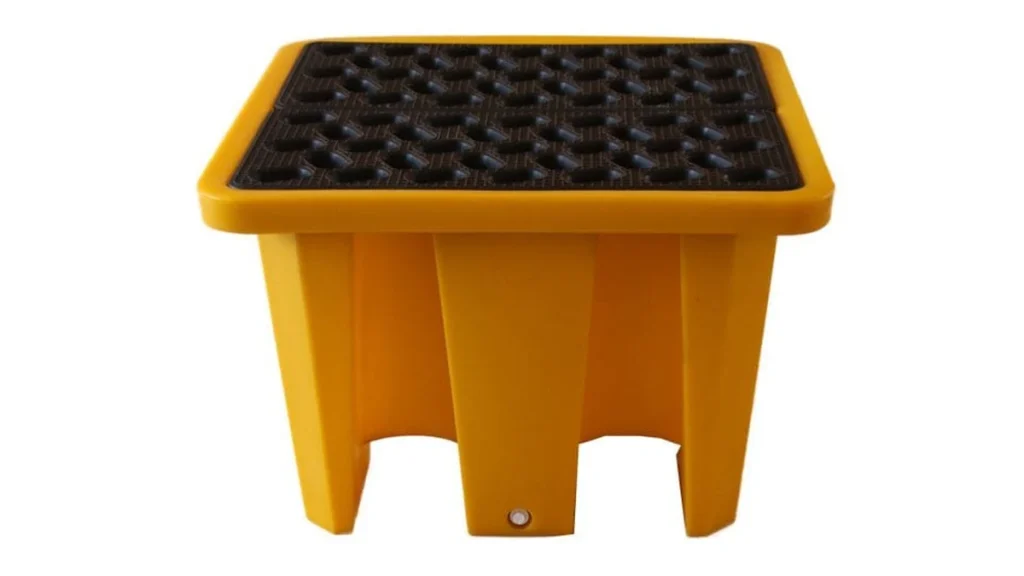
Choosing a drum spill pallet starts with the drum, not the pallet. A model that looks suitable in a catalogue can still be wrong for the job if the drum footprint, filled weight, containment requirement or handling method has not been checked. For a buyer sourcing equipment for a warehouse, workshop or chemical-storage area, the useful question is: what information must be confirmed before a model is selected?
This guide is for buyers comparing drum spill pallets for industrial liquid storage. It focuses on the decisions that change the product choice: drum count, footprint, secondary-containment volume, material, deck design and how the product will be positioned or moved. It does not replace a site’s own EHS requirements or local rules for the liquid being stored.
Start with the drum arrangement
First confirm how many drums will sit on one unit. A single-drum tray and a multi-drum pallet solve different storage problems. The number of drums affects the outside footprint, the usable area on the deck and the containment volume that the project may require.
Do not assume that every drum described as 200 L has the same outside dimensions. Ask the user of the storage area for the drum diameter, height and any fittings that extend below or beyond the drum. A pump, tap or dispensing attachment can change the clearance needed around the drum. If the pallet will be placed against a wall, under a rack or beside a workbench, include that layout in the request.
Zhenghao’s single-drum range shows why this check matters. The industrial single drum spill tray is listed at 675 × 675 × 150 mm with a 43 L drum capacity. Another single-drum model, the one drum spill containment platform, is listed at 900 × 900 × 600 mm with a 202 L drum capacity. Those are different product envelopes, not interchangeable versions of the same requirement.
Check the containment requirement before comparing outside dimensions
The sump is the space below the grate that receives drips or leaked liquid. Buyers often compare only the footprint because it is easy to see in a product photo. The containment volume is normally the more useful number when the product is being considered for liquid storage.
Ask the site team what level of secondary containment is required for the number and type of drums being stored. The answer may depend on internal procedures, the stored liquid and local requirements. The supplier should receive that requirement in litres or gallons, rather than being asked to choose a pallet from a photo alone.
Product data should be compared model by model. For example, the HDPE single drum spill capture tray is listed with a 40 L drum capacity, while the 675 × 675 × 150 mm model above is listed with 43 L. A larger-looking unit does not automatically provide the right containment capacity. Confirm the actual published figure for the selected model and check it against the project’s requirement.
Separate static support from moving the product
A drum spill pallet may be used as a fixed storage base, moved empty into position, or moved with drums on it. Those are different conditions. Do not treat a static-load value as permission to move a loaded unit. Check the published static and dynamic load figures for the exact model, then compare them with the planned handling method.
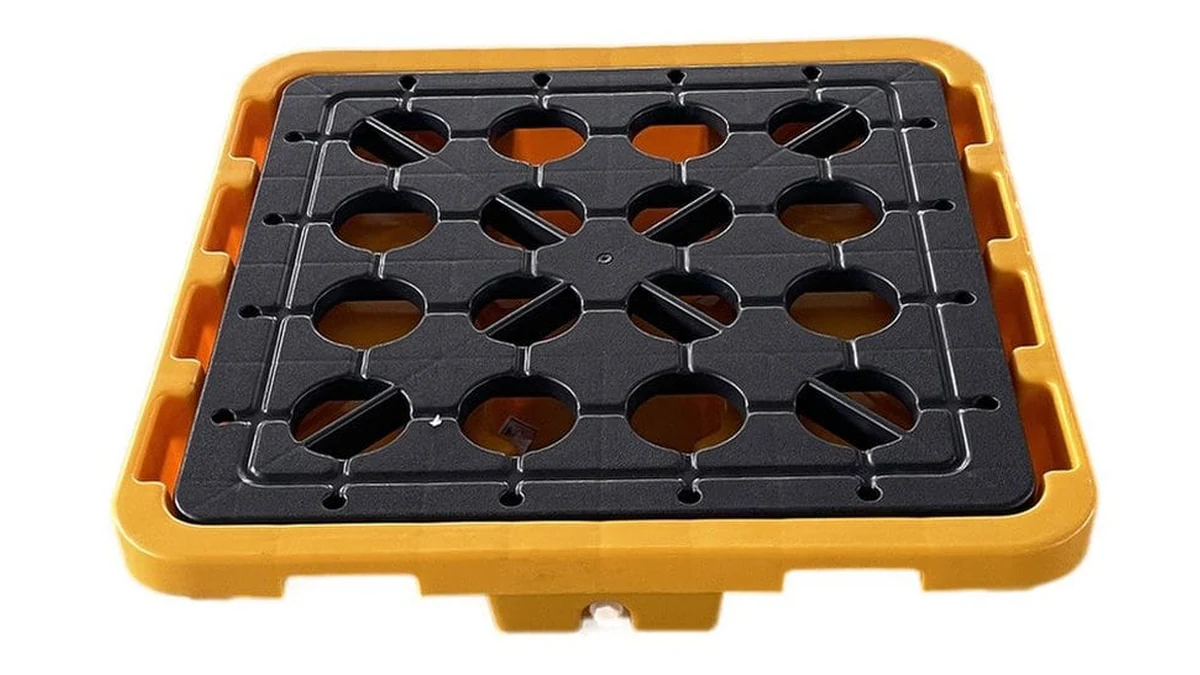
For example, Zhenghao lists the 720 × 720 × 155 mm single-drum spill capture tray with a 500 kg static load and a 300 kg dynamic load. The 850 × 850 × 155 mm single drum spill prevention pallet is listed with 800 kg static load and 500 kg dynamic load. These figures belong to the named product pages. They should not be transferred to another tray or pallet without checking that model’s own data.
Ask how the unit will be handled: forklift, pallet truck, manual positioning or fixed placement. Confirm the entry direction, fork length, floor clearance and whether the selected product is intended to be moved while loaded. If the site will place the spill pallet first and then load the drum separately, say that too. It changes the handling requirement.
Review material against the stored liquid and site conditions
The listed single-drum models above use HDPE. That confirms the product material, but it is not a universal chemical-compatibility statement. A buyer should provide the liquid name, concentration where relevant, temperature and exposure conditions to the site’s safety team and to the supplier before final selection.
Also describe whether the pallet will be used indoors, outdoors, near a dispensing point or in a fixed chemical-storage zone. Sunlight, temperature, cleaning practice and the risk of repeated drips can affect the practical choice. The aim is to match a real use condition to a real product specification, rather than relying on a general phrase such as “chemical resistant.”
Look closely at the deck and cleaning access
A removable grid deck keeps the drum above the sump and gives operators access for inspection and cleaning. Several Zhenghao single-drum products list removable or anti-slip grating. That feature is useful only if the site can inspect the sump safely and remove the grate in its normal work routine.
Before requesting a quotation, ask who will inspect the unit, how collected liquid will be handled under site procedures and whether the product will need frequent wash-down. These questions are operational rather than decorative. They determine whether a compact tray, a deeper pallet or a different containment layout is more practical.
Do not confuse a spill tray with a drum spill pallet
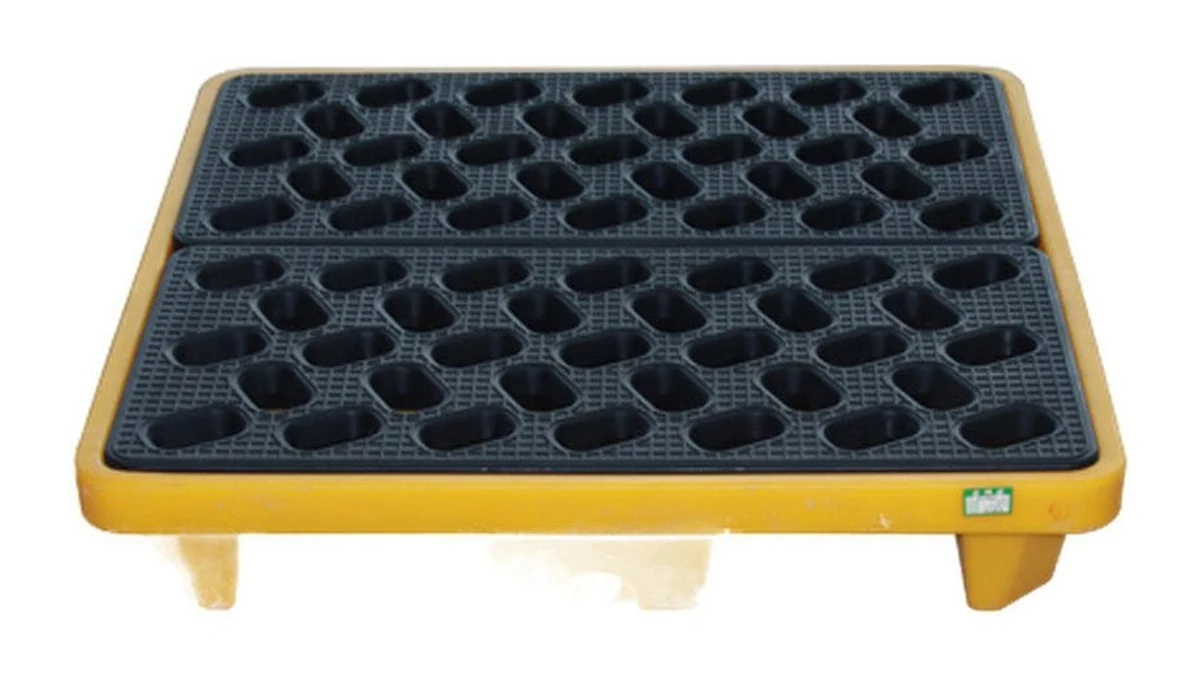
The names overlap, and suppliers may use them differently. For selection, focus on the published dimensions, containment volume, load figures and intended handling rather than the product name alone. A lower tray may suit a dispensing point or a compact workspace. A deeper containment pallet may suit a fixed drum-storage area where a larger sump is required. Neither option is automatically better.
It is also worth checking whether the buyer needs a single product or a small system. Zhenghao’s spill containment plastic pallets category includes drum-related containment products alongside other formats. A site that stores drums in one area and uses smaller containers at a maintenance point may need more than one containment format. The request should describe each location separately.
Common mistakes during product comparison
The first mistake is to compare only the advertised drum count. Two products can both be described as single-drum units while having different dimensions, sump capacity and load figures. The second is to use a product’s overall height as a substitute for containment volume. Ask for the published capacity of the exact model.
Another mistake is to assume that HDPE answers every liquid question. It identifies the product material, but the buyer still needs to provide the actual liquid and operating conditions for review. A fourth mistake is to leave handling until after the product has been selected. Forklift access, pallet-truck use and fixed placement should be part of the first request, because they affect the practical use of the unit.
Finally, do not add an unverified requirement to a purchase order just because a similar product page uses a familiar phrase. Confirm the dimensions, capacity, static load, dynamic load and deck arrangement on the relevant product page or product drawing. When a requirement is not yet known, record it as an open item instead of guessing.
When a product drawing is useful
A drawing is especially helpful when space is limited, drums are loaded from a specific side or the storage area includes existing equipment. It allows the buyer to compare the product footprint with the available floor area and check access around the drum. For a repeat order of a known model, the published product page may be enough. For a new project, a changed drum or an unusual layout, the drawing and the site layout should be reviewed together before the order is confirmed.
Information to send before requesting a recommendation
A short, complete request usually prevents several rounds of product comparison. Include the following information:
- Number of drums per storage point and the drum’s outside dimensions.
- Filled drum weight and the liquid name.
- Required containment volume, if the site has one.
- Indoor or outdoor location, plus the available floor area.
- Whether the unit will stay in place or be moved, and the handling equipment involved.
- Expected order quantity, destination and any drawing or layout available for the project.
With those details, Zhenghao can compare appropriate models from the drum spill pallet range and confirm the published specifications that apply to each one. That is a better starting point than selecting on size or price alone.
Questions buyers often ask
What is a drum spill pallet?
A drum spill pallet is a secondary-containment platform for storing one or more liquid drums. The drum stands on a grate above a sump, which can receive drips or leaked liquid. The term does not define one standard size or capacity. Buyers still need to check the selected model’s deck area, containment volume, load data and handling method.
How many drum spill pallets do I need?
Count the drum storage points first, then group the drums only where the chosen pallet is designed for that arrangement. A site with four drums does not automatically need one four-drum pallet. Separate work areas, limited floor space, different liquids or different handling routes may require several units. Confirm the required containment volume and site procedure for each location before deciding the quantity.
A practical final check
Before confirming a model, compare the actual product page with the project brief one more time. The drum must fit the deck. The published containment capacity must meet the site’s requirement. The static and dynamic figures must match how the unit will be used. The material and operating conditions must be reviewed for the stored liquid. Finally, the site needs a workable inspection and cleaning routine.
A drum spill pallet is part of a storage procedure, not a generic plastic platform. When the purchase request includes the drum, liquid, containment, handling and layout details, the product choice becomes much clearer.