
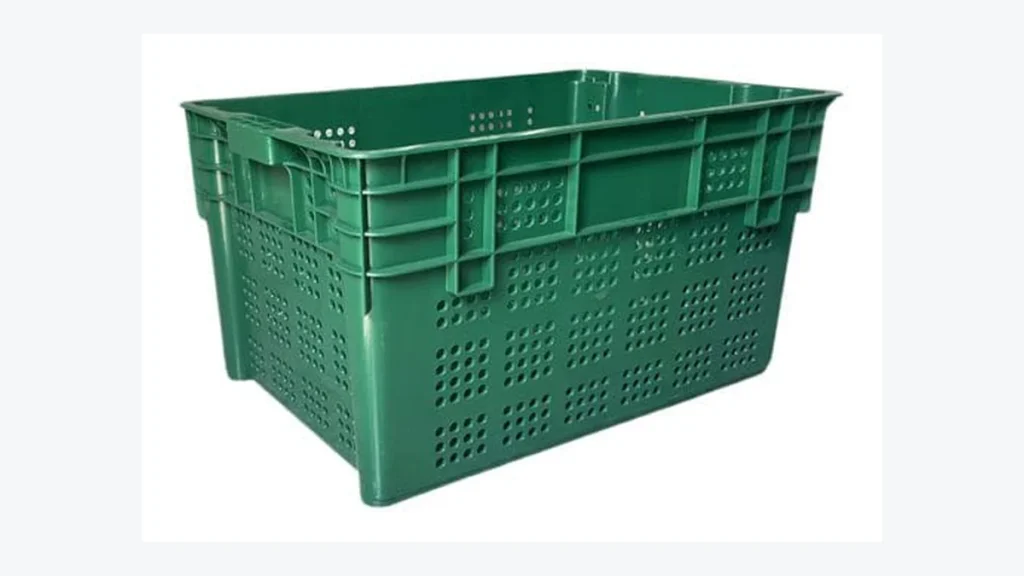
Stackable and nestable plastic crates solve different parts of the same handling problem. A stackable crate uses its base and rim to remain stable on another crate. A nestable crate fits inside another empty crate to reduce the space needed for storage and return transport. Some models can do both, but only when they are placed in the correct orientation.
For a buyer, the label alone is not enough. The crate must match the goods, loaded weight, empty return route, handling equipment and available storage space. This guide explains what to compare before requesting a quotation.
What is a stackable plastic crate?
A stackable crate is designed so that the base of one crate sits securely on the rim or stacking points of the crate below it. This arrangement helps buyers use vertical storage space while keeping loaded crates separated.
Stacking performance depends on the actual model, the load inside each crate and the way the stack is handled. Buyers should ask for the permitted loaded stacking condition rather than assuming that every plastic crate can carry the same stack height or weight.
What is a nestable plastic crate?
A nestable crate has tapered walls or another compatible shape that allows empty units to fit inside one another. Nesting is useful when empty crates return to a warehouse, supplier or packing point. The space saving depends on the crate geometry and nesting height, so it should be confirmed from the selected model.
Nesting applies to empty crates. A buyer should not treat a nested stack as a loaded storage arrangement.
Stackable vs nestable crates: the practical difference
| Buying question | Stackable crate | Nestable crate |
|---|---|---|
| Main purpose | Stable vertical storage when crates are loaded | Lower storage and return volume when crates are empty |
| Shape | Base and rim are designed to locate securely | Walls or profile allow one empty crate to enter another |
| Buyer must confirm | Loaded stacking condition and stack stability | Nesting height, orientation and empty handling method |
| Typical decision factor | How loaded goods are stored and moved | How empty packaging is collected and returned |
Can one crate be both stackable and nestable?
Yes. Some returnable crates stack in one orientation and nest after they are turned or repositioned. This gives the operation loaded stacking and empty return savings in one design. The exact movement differs by model, so the supplier should show how the crate changes between stacking and nesting positions.
Zhenghao lists a stackable nestable logistics crate and other nestable plastic crates for buyers comparing this type of returnable packaging.
Choose according to the full handling cycle
Start with the goods and loaded condition
Record the product size, total loaded weight and any need for airflow, drainage or solid-wall containment. Confirm whether the goods project above the rim and whether the crate will be stacked by hand, on a cart or as part of a larger unit load.
Measure the empty return route
If empty crates travel back through the same network, compare the number of empty units, available vehicle or warehouse space and the labor needed to separate nested crates. A nestable design has the most value when empty packaging occupies a meaningful part of the return flow.
Check external and usable internal dimensions
External dimensions affect shelves, carts, conveyors and pallet patterns. Internal dimensions determine whether the goods fit without pressure or wasted space. Ask for both sets of dimensions for the exact model. Do not select a crate from its outside footprint alone.
Confirm the stacking and nesting instructions
Request a clear demonstration or drawing showing the correct orientation. The quotation should identify the loaded stacking condition and the empty nesting height. If lids, dividers or labels are required, confirm that they do not interfere with either function.
Select the wall design separately
Stacking and nesting describe the crate structure, not whether its walls are open or closed. Ventilated walls can support airflow and drainage, while solid walls help contain small items or residue. The separate guide to vented vs solid plastic crates covers this decision in more detail.
Common buying mistakes
- Comparing only the unit price and ignoring the cost of storing or returning empty crates.
- Assuming that a crate described as stackable also nests when empty.
- Using external dimensions as if they were the usable internal space.
- Quoting a stack height without confirming the load and handling condition.
- Choosing wall ventilation before checking the goods, cleaning process and drainage needs.
Information to send with an RFQ
A useful quotation request should include the goods, required internal space, expected loaded weight, quantity, empty return method, stacking requirement, wall type, handling equipment, color or identification needs and destination. If the crate must work with an existing shelf, cart, pallet or conveyor, include those interface dimensions.
Buyers can review the broader plastic crate range or send Zhenghao the handling requirements for a model-specific comparison.
Frequently asked questions
Are nestable crates safe to stack when loaded?
Only if the selected model is designed for both functions and is placed in its stacking orientation. Confirm the loaded stacking condition with the supplier.
Which option is better for returnable logistics?
A nestable or stackable-nestable crate may reduce empty return volume, but the final choice still depends on the loaded goods, route, handling method and required internal space.
Can stackable and nestable crates use PP or HDPE?
Yes. Zhenghao can make plastic crates in PP or HDPE depending on the model and project requirements. The material option should be confirmed for the selected crate.