
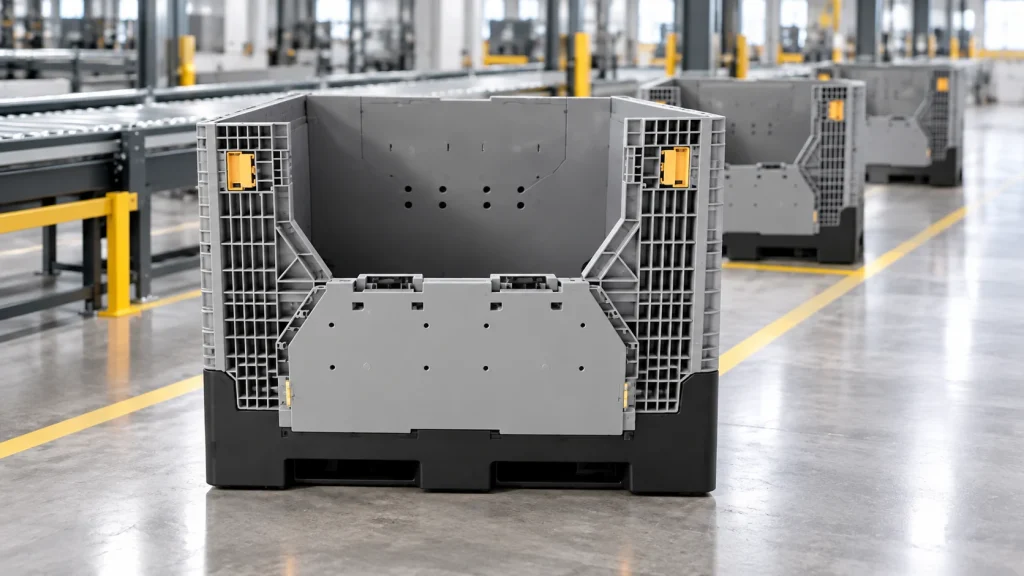
Reusable pallet boxes are chosen for routes where a bulk container needs to move out, be emptied and return for another cycle. The box itself is only part of that decision. Buyers also need a workable plan for packing, loading, storage, empty returns and responsibility at each handover point.
This checklist is for buyers preparing an enquiry through Zhenghao’s Pallet Boxes range. Use the category and product pages to compare current models. Use the questions below to describe the operating route before asking for a model recommendation.
Map the container loop first
Write down where each pallet box is filled, dispatched, received, emptied, held and returned. A closed loop between two sites has different needs from a route that passes through several warehouses, suppliers or customer locations. The route should also show who controls each handover.
Include the expected turnaround time. A container returned after each delivery is managed differently from one held at a destination until a scheduled collection. This information helps separate a practical reuse programme from a simple one-way shipment.
Describe the goods, not just the box
State what goes into the container, how the goods are packed and whether they need bags, liners, dividers or other protection. Include the approximate packed quantity and weight for the actual shipment. Product pages should be used to confirm the dimensions and configuration of the shortlisted model.
Photographs, a packing sketch and the outside dimensions of the goods are often more useful than a generic request for a large container. They show whether loading, unloading and access need special attention.
Separate loaded storage from empty return
Record where loaded containers wait before dispatch and where empty containers wait after use. These two stages may have different space limits, handling equipment and collection schedules. The buyer should describe both, rather than assuming that one storage arrangement will suit the complete loop.
If empty return space is a priority, explain the intended return method. Buyers can then compare current Foldable Pallet Boxes and fixed-wall alternatives against the real route instead of treating either structure as a universal answer.
List every handling point
Describe how the pallet boxes move through the operation. This may include loading stations, forklift transfers, warehouse staging areas, delivery vehicles and unpacking points. The relevant question is whether a selected model fits the actual handling sequence, not whether it sounds suitable in a general description.
For a fixed-wall model route, review the current 1200×1000 Heavy-Duty Plastic Pallet Box page and request confirmation against the planned process. The product page is the place to check the specific model, not this general guide.
Decide how users access the contents
Explain whether operators need to reach into the box during picking, whether goods are removed from above, or whether the container is emptied at a dedicated station. Access requirements can affect the shortlist even when two options have a similar footprint.
Also identify any points where the container must be opened, closed, inspected or cleaned. These operational details are often missed when an enquiry only states a size or a target quantity.
Set a return and ownership routine
A reusable system needs a simple answer to three questions: who owns the containers, who arranges their return and who reports missing or damaged units. State whether the boxes return with the same vehicle, through a separate collection run or after consolidation at a regional site.
Where several companies share the route, identify the person who can confirm the return process. This keeps a product discussion connected to the way the programme will actually operate.
Plan identification and cleaning
Give the supplier the identification needs that are relevant to the project, such as colours, labels or route markings. Explain who applies and maintains those identifiers. If cleaning is part of the return cycle, describe where it happens and what the local process requires.
These are buyer-supplied operating conditions, not automatic features of every pallet box. They should be confirmed for the selected model and order.
Compare structures against the route
Fixed-wall, foldable and other pallet-box structures have different operating roles. The right comparison begins with the goods, empty return method, handling points and access requirements. For a structural comparison, read Foldable vs One-Piece Plastic Pallet Boxes after defining the route.
Do not treat a general comparison as a substitute for a model check. Exact dimensions, materials, capacity, loading conditions and any optional configuration must be confirmed on the relevant product page and quotation.
Prepare a useful enquiry
A clear enquiry includes the goods, packing method, route map, approximate quantity, loaded storage plan, empty-return plan, handling points, access needs, cleaning process, identification needs, destination and timing. This gives the supplier the information needed to compare current options without making assumptions about the application.
If the project needs a tailored container discussion, the Custom Pallet Box Quote Checklist can help organise the project details before model-specific confirmation.
Use this checklist before contacting a supplier
- Forward route, receiving points and empty-return method
- Contents, packing pattern and approximate shipment quantity
- Loaded storage space and empty-container holding space
- Handling equipment, transfer points and access requirements
- Ownership, collection, cleaning and identification process
- Preferred delivery timing and destination
Where to go next
Browse the current Pallet Boxes and product pages once the route is defined. When the brief is ready, send Zhenghao an enquiry for a model-specific discussion.