
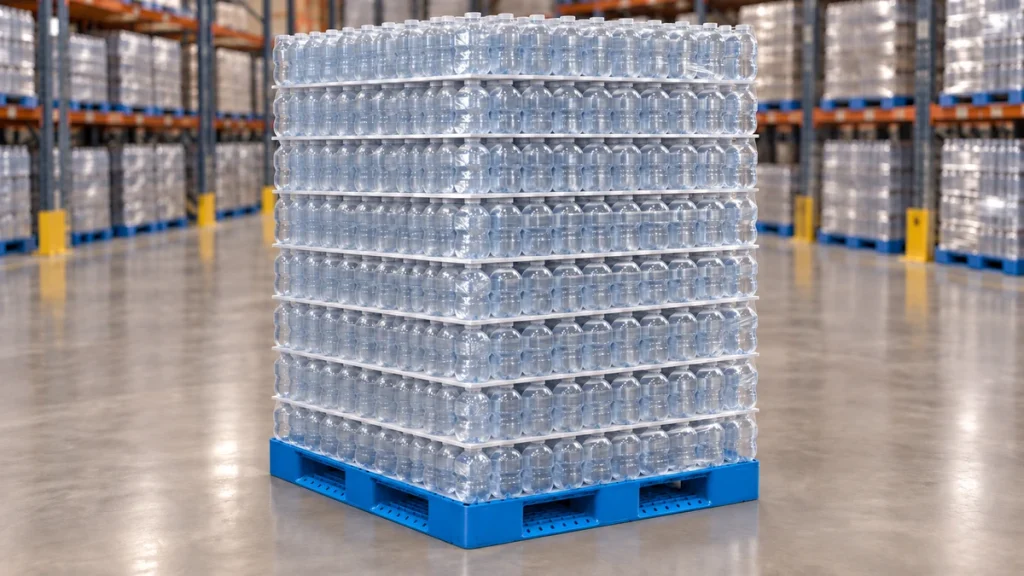
Bottled water can look like a straightforward pallet application. The packs are uniform, the loads are usually wrapped, and the product moves through a familiar warehouse route. In practice, small differences in bottle format, pack layout and handling equipment can change what the pallet needs to do.
Choose the pallet from the complete unit load rather than from the bottles alone. The pack dimensions, number of layers, wrap pattern, transfer equipment and storage support all affect the final model check. This guide explains the questions worth answering before you request a quotation.
Start with the complete unit load
Describe what will sit on the pallet when it leaves the packing line. Include the bottle size, pack or tray format, cartons if used, the planned layer pattern and whether the load is wrapped. A pallet that looks large enough can still be a poor fit if the outer packs overhang, the load is not evenly supported, or the wrap does not hold the pattern together during movement.
It also helps to provide a photo or a simple drawing of the finished load. That gives the supplier a clearer view of the contact area and any gaps below the packs. The plastic pallets category can help you compare the available families, but it cannot replace this unit-load check.
Check how the packs sit on the deck
Look at the underside of the outer packs and trays. Some loads sit on a broad, flat base. Others have raised feet, narrow contact points or flexible film around the bottom. The deck should support the real contact pattern, not an idealised rectangle.
For bottled-water loads, uneven contact can become more noticeable after repeated handling. Ask whether the selected deck gives suitable support beneath the actual pack layout. If the operation uses a slip sheet, divider or another layer between the pallet and the goods, include that in the description as well.
Plan the handling route, not one lift
A pallet may be moved from the filling area to staging, loaded into a vehicle, received again and placed in a different warehouse. List each handling step. Note the forklift type, fork size, approach direction, turning space and whether equipment picks the pallet when it is empty, loaded or both.
Fork entry needs its own review. The 2-way and 4-way pallet-entry guide explains why approach direction should be checked separately from pallet strength. A forklift can have access from a particular side without that answer proving pallet-jack compatibility or fit for every later step in the route.
Keep storage support in the specification
State where the loaded pallet will rest between moves. It may sit on the floor, on a platform, in a vehicle, on a conveyor or in another storage arrangement. Each support condition should be described when the model is reviewed. Do not assume that a pallet selected for transport has the same fit for every storage method.
If the operation is comparing structural formats, the six-runner plastic pallets and double-deck plastic pallets categories provide useful product routes. The product page and final recommendation should still be tied to the intended support condition.
Consider water exposure and cleaning in context
Bottled-water operations may involve wet floors, wash-down routines or occasional leakage from damaged packs. Explain the actual environment instead of using a general label such as “wet area.” The supplier needs to know where water appears, how often the pallet is cleaned and whether the pallet moves between clean and non-clean areas.
These details help the discussion stay practical. They do not automatically establish a material grade, hygiene status or chemical compatibility. Those are model-specific matters that should be confirmed before ordering.
Do not use pallet weight as a shortcut
A pallet’s own weight does not tell you how a particular bottled-water unit load will perform. It is only one product characteristic. The final choice depends on the selected model, its stated use conditions, the support below the pallet and the handling route.
A published plastic pallet for water bottles can be a useful product-page reference, but buyers should confirm the current model details with the supplier rather than treating a related page as a universal specification.
Prepare a better quote request
A useful inquiry includes the pallet size required, the finished load layout, the approximate total load, handling equipment, storage support, the operating environment and the destination or transport method. Mention whether the load needs to be moved repeatedly or only stored for a short period. This gives the supplier enough context to recommend a model rather than guessing from a product name.
For a wider view of food and beverage handling questions, read how to choose plastic pallets for food and beverage logistics. That guide covers the broader application. This page stays focused on bottled-water unit loads.
Choose the model after the facts are clear
For bottled water, start with the completed unit load and the real route through the operation. Then compare product options against those conditions. Avoid selecting a pallet solely because it appears to suit a similar case of bottled water.
Send Zhenghao the load layout and handling details when you are ready to compare models. Request a model check with the conditions that matter to your operation.