
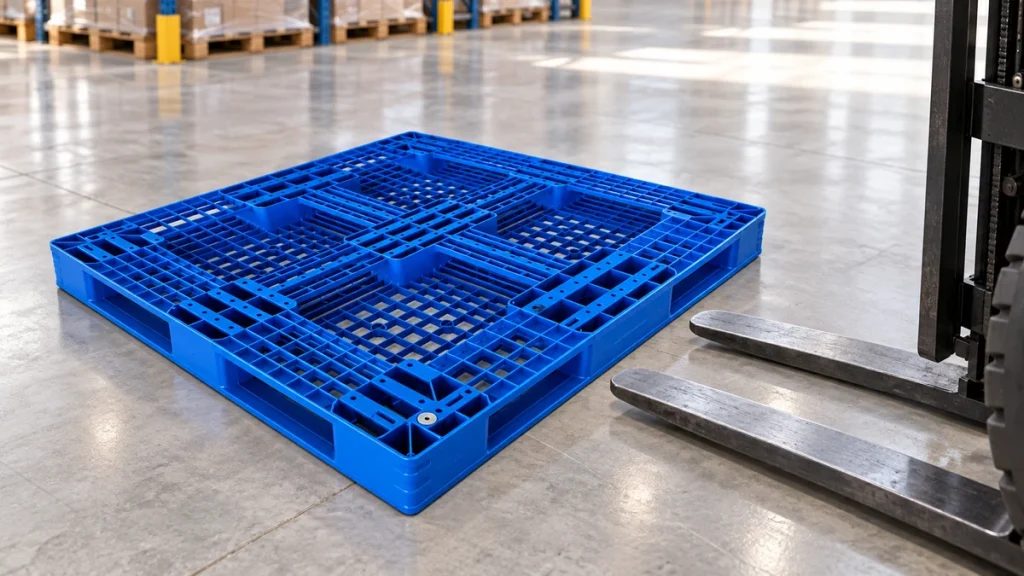
Fork entry is easy to overlook when a plastic pallet looks suitable on paper. It often becomes important only when a driver needs to approach the load from a different aisle, turn in a tighter staging area, or work around a fixed loading position. Before comparing deck styles or dimensions, buyers should confirm how the forklift will reach the pallet in the real handling route.
The terms 2-way and 4-way describe the sides from which forklift forks can enter. They do not, by themselves, confirm pallet-jack use, racking suitability, load capacity, material, or automation compatibility. Those details remain model-specific and should be checked on the product page and in the final quotation.
What 2-way plastic pallet entry means
A 2-way entry pallet has openings on two opposite sides. The forklift needs to approach from one of those sides. This can work well when the movement is predictable: pallets are picked from the same direction, loading bays have a fixed approach, and aisle access is planned around the pallet orientation.
The practical question is not whether two entry sides are enough in theory. It is whether they match the route from receiving to storage, staging, production and dispatch. A pallet that works at the loading door can still slow the operation if it must be turned before every later pick.
What 4-way plastic pallet entry means
A 4-way entry pallet allows forklift approach from all four sides. That gives the operator more choices when the pallet position changes during handling. It can be useful where loads are staged in mixed orientations, aisles are busy, or a forklift needs to approach from the side rather than the end.
More approach options do not automatically make a pallet the right choice. The base layout, the fork dimensions, the loaded condition and the equipment all still matter. Treat 4-way entry as an access feature, then check the rest of the handling requirement separately.
Entry direction is separate from pallet strength
It is tempting to use entry type as a shortcut for a heavier or lighter pallet. That shortcut causes mistakes. A pallet’s ability to support a particular load depends on its own design and the stated conditions of use. The same applies to its suitability for a particular storage arrangement.
Ask for the exact model before making a decision. Confirm the load condition, the support beneath the pallet, the handling equipment and whether the pallet will be stored, transported or repeatedly moved. The plastic pallets category is a useful starting point for comparing available structures, but the final choice should stay tied to the individual model.
Check the forklift and pallet jack separately
Forklift access and pallet-jack access are not interchangeable terms. A forklift may be able to enter a pallet from a given side while a pallet jack has different clearance, wheel and fork requirements. Do not assume one result from the other.
For a clear inquiry, provide the fork width and length, the equipment type, the approach direction, and whether the pallet must be picked when empty or loaded. If powered or manual pallet-jack handling is part of the route, state that separately. This gives the supplier the information needed to check the actual opening and base design.
Map the route before choosing the entry type
Walk through the handling route instead of looking only at the pallet in isolation. Note how the pallet arrives, where it is turned, how it is staged, and which side faces the forklift at each step. A simple sketch often reveals whether the operator needs access from only two directions or may need to approach from any side.
This check is especially useful when loads move between receiving, production and outbound staging. A change in orientation at one stage can create an avoidable extra movement at the next stage.
Base structure and entry need to be reviewed together
Entry openings are part of the base structure, so compare them alongside the deck and runner layout. Buyers who are considering a runner design can review the available three-runner plastic pallets and six-runner plastic pallets. For a reversible format, the double-deck plastic pallets category provides another structure to compare.
These categories help narrow the discussion, but they do not replace a model-level check. A full-perimeter grid pallet example may be useful for reviewing a visible base layout, while the actual entry and handling fit must still be confirmed for the model you select.
Questions to include in a purchase inquiry
Send the information that affects access rather than only asking for a 2-way or 4-way pallet. Include the goods, pallet size needed, whether the load is evenly supported, forklift or pallet-jack details, the route through the facility and the storage method. If the pallet will be used with more than one vehicle or location, describe each condition.
This avoids a common mismatch: a pallet selected for one approach direction that becomes inconvenient after it enters a different part of the operation.
Choose the model after the access check
Use 2-way entry where the route is controlled and the two available approach sides suit the job. Consider 4-way entry where flexible forklift approach is genuinely needed. Then verify the selected model against the real handling conditions before ordering.
If you would like help comparing the available options, compare three-runner and six-runner pallet structures, review the relevant category pages, or send Zhenghao your handling details for a model check.