
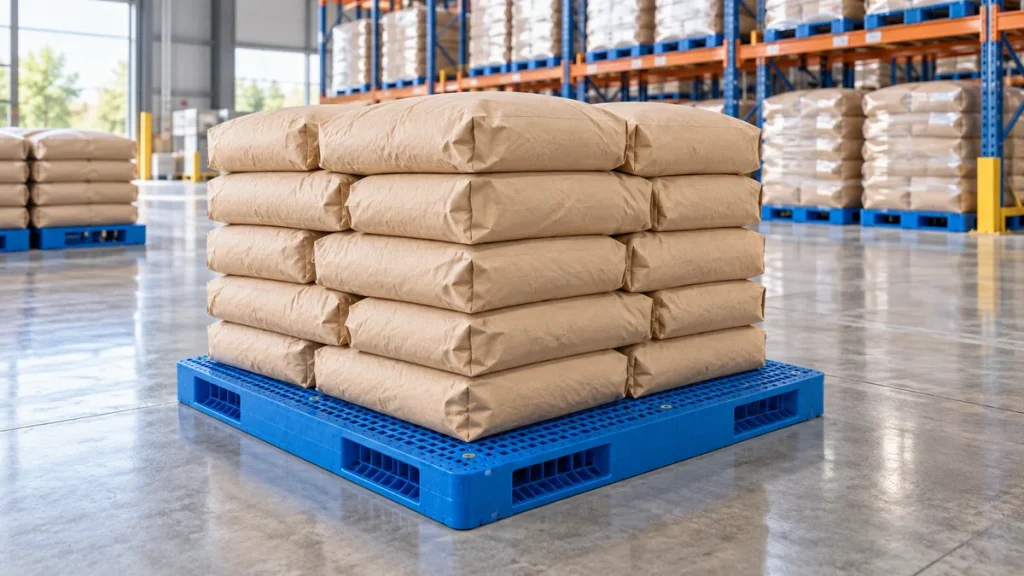
Bagged materials can look easy to palletize, but the load behaves differently from rigid cartons or containers. Sacks can settle, bulge and shift as they are handled. Their contact area also changes with the fill material and bag construction. A suitable plastic pallet must therefore be selected around the complete unit load, not only the pallet footprint.
This guide explains the information a buyer should confirm before comparing plastic pallets for fertilizer, resin, feed, powder and other bagged products. It does not replace the model-specific data on a product page or a review of the actual handling route.
Start with the bag and the load pattern
Record the filled bag dimensions, individual bag weight and number of layers. Note whether the bags are paper, woven fabric or film and whether they become soft or uneven after filling. These details affect how the load contacts the deck and whether edges or corners extend beyond the pallet.
The stacking pattern matters too. Interlocked layers can behave differently from column-stacked bags. If a slip sheet, stretch film, corner board or top sheet is part of the unit load, include it when the pallet is reviewed. The supplier needs to assess the system that will actually move through the warehouse.
Match the deck to the bag surface
A grid deck can reduce pallet weight and support airflow or drainage, while a flat deck gives a more continuous contact surface. Neither option is automatically correct for every sack. Fine, flexible packaging may need closer support than a stiff bag with a broad, stable base.
Check whether the bag material can press into deck openings, especially at the bottom layer. Also consider contamination, cleaning and any loose material that could collect on the deck. Record the required surface support so the supplier can compare suitable deck options.
Do not treat every load rating as the same
Static, dynamic and racking loads describe different support and movement conditions. A figure measured while the pallet is fully supported on a level floor cannot be used as proof of performance while the pallet is being lifted or supported across rack beams.
Ask for the rating that matches the planned operation and the exact pallet model. Load distribution, support spacing, temperature and handling frequency can all affect the decision. If the application includes racking, provide the rack geometry rather than relying on the word “rackable” alone.
Choose a base structure for the handling route
Bagged goods may move by forklift, pallet truck, conveyor or a combination of equipment. Confirm the required entry directions, fork dimensions and support points. A double-deck or full-perimeter structure may be considered for demanding circulation and stacking conditions, while other bases may be appropriate for different routes.
Use the double deck plastic pallet category to compare available structures, but verify the suitability of each model separately. The three-runner and six-runner pallet comparison also explains why base geometry must be matched to the handling system. A category name is a useful starting point, not a substitute for product data.
Separate floor storage, loaded stacking and racking
These three conditions place different demands on a pallet. Floor storage normally gives broad support beneath the base. Loaded stacking transfers force through the bags and any intermediate surfaces. Beam racking leaves part of the pallet unsupported between contact points.
Tell the supplier which conditions occur, how long the load remains in storage and whether the pallet is moved while loaded. If loaded units will be stacked, describe the intended stack height and how the upper pallet contacts the bags below. Do not use a photograph of empty pallets as evidence of loaded stacking performance.
Consider bag stability during movement
A pallet can be strong enough for the weight and still perform poorly if the bags slide or the load overhangs. Check deck friction, stretch-wrapping practice and the stability of the bottom layer. Sudden stops, fork entry and uneven floors can expose weaknesses that are not visible in static storage.
For a wide, double-sided welded structure intended for fertilizer applications, buyers can review the 1500 x 1300 fertilizer pallet as one model-specific reference. Its published details apply to that product only and should be checked against the real load and equipment.
Review the operating environment
Temperature, moisture, dust and cleaning methods may influence the pallet choice. Outdoor holding areas and cold spaces can present different conditions from a dry indoor warehouse. Tell the supplier about expected temperatures, chemical contact and cleaning agents so the material and structure can be reviewed for the application.
If impact resistance and outdoor handling are priorities, the blow-molded double-deck pallet range provides another structure group to compare. Do not assume that manufacturing process alone determines the correct model.
Check size against the whole logistics system
The pallet must fit more than the bags. Confirm compatibility with doors, staging lanes, rack openings, vehicles and destination equipment. Allow for stretch film, corner protection and any controlled overhang. A larger pallet may improve support but can reduce transport or warehouse efficiency if the complete route was not considered.
A second model example is the 1400 x 1200 blow-molded fertilizer pallet. Compare its published construction and handling information with the welded model rather than treating the two products as interchangeable.
Send a complete pallet inquiry
A useful request should include the bag dimensions and weight, bags per layer, number of layers, total unit-load weight and a photo or drawing of the stacking pattern. Add the required pallet footprint, handling equipment, entry directions, storage method, rack support details, operating temperature, cleaning requirements and expected order quantity.
Also state whether the route is one-way or closed-loop and whether loaded pallets will be stacked. This information helps the supplier shortlist models without making assumptions about the load.
Compare real models before ordering
There is no single plastic pallet for every bagged material. The best choice depends on how the bags contact the deck, how the load is restrained and where the pallet is supported during storage and movement. Begin with the unit load, then compare model-specific dimensions, structure and ratings.
Send Zhenghao your bag, load and handling details for a model review and quotation. Final selection should be based on the published product information and the actual operating conditions.