
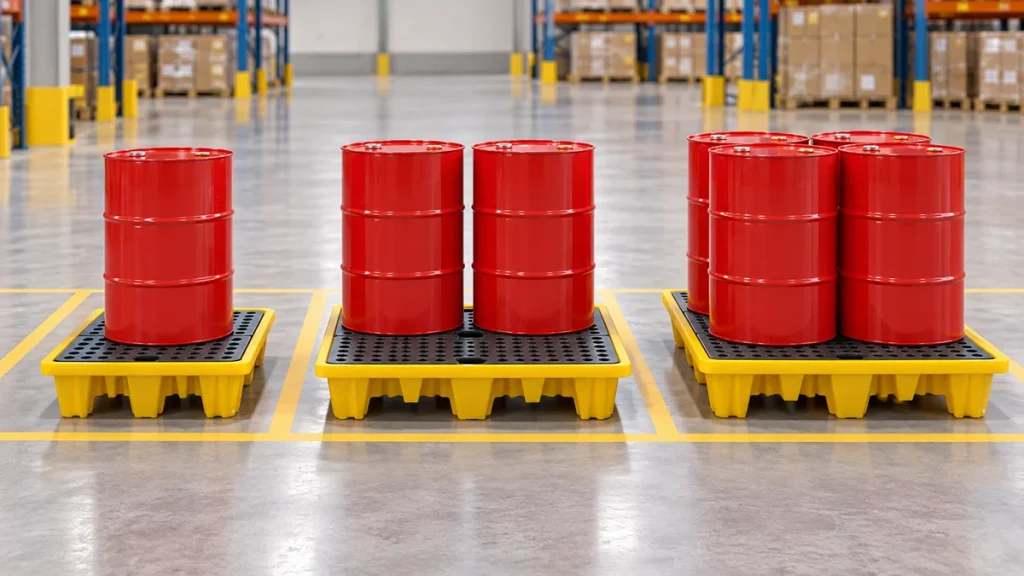
Buying a drum spill pallet is often treated as a simple one-for-one question: count the drums, then choose a pallet with enough positions. A working storage area is usually more complicated. Drums may be held in a main store, staged near a process line, waiting for collection, or set aside while a team checks a damaged container. Each of those places can need its own containment plan.
This guide helps buyers work out how many containment positions they should plan for before asking for model recommendations. It does not set a legal containment requirement. The required capacity and operating procedure must be confirmed against the stored liquid, the site rules, and the local requirements that apply to the project.
Count active storage positions, not only the total drum inventory
Start with the places where drums are actually stored or handled at the same time. A site may own fifty drums but keep only eight in an active storage zone, two at a dispensing point, and several more in a receiving area. Those groups do not always need the same containment product or the same physical layout.
Make a simple list for each area: the number of drums normally present, the largest expected temporary quantity, the drum footprint, and whether the drums stay in place or move during the shift. This turns a warehouse total into a practical count of containment stations.
Separate long-term storage from working positions
A main drum store is different from a point where operators draw product, collect empty drums, or prepare materials for a production line. The storage area may need a stable layout for repeated inspection. A work area may need room around the drums for access, tools, or a transfer process.
Do not assume that the pallet used for a fixed storage row is automatically the right choice for a temporary work position. Review the handling method and the space around each zone before combining the counts. A compact tabletop spill tray may be relevant for a small container or bench task, while drum storage needs a different product family.
Plan for receiving, quarantine, and empty-drum areas
Receiving and maintenance areas are easy to miss because their contents change. A delivery may arrive before the main store has free space. A drum with a damaged label, a suspected leak, or an unresolved identification issue may need to stay apart from normal stock until the site team decides what to do.
Ask the operations team whether those areas are permanent, seasonal, or only used during peaks. If they are part of the normal flow, include them in the initial quantity plan instead of treating them as an emergency after the order is placed. The result may be a separate containment position, not simply a larger main storage row.
Use the actual layout to decide how stations are grouped
After counting the stations, draw the floor plan. Mark doors, travel lanes, posts, racking, process equipment, drains, and the space needed for routine access. A plan that looks efficient on paper can become difficult to inspect if drums are placed too close to a wall or if operators cannot reach the grate and sump safely.
Group drums only where the operating route makes sense. A row that is too long may create unnecessary movement. Several smaller groups may make it easier to separate materials, manage stock rotation, or keep a clear route through the area. The correct arrangement depends on the real work sequence, not only on the maximum number of drum positions shown in a catalogue.
Choose product families after the station count is clear
Once the number and location of stations are known, review the available drum spill pallets and compare each model against the proposed arrangement. Check the published dimensions, sump capacity, deck configuration, entry details, and handling instructions for the exact model.
A single-drum position, a paired drum location, and a larger storage group may lead to different model discussions. Do not use the model name alone as proof that it fits the project. The page Spill Containment Pallets for Drum Storage explains the model-level checks that should follow a quantity plan.
Keep containment capacity as a separate approval step
The number of pallet positions does not settle the required containment capacity. Capacity depends on the stored liquid, the number and size of containers, the operating conditions, and the requirements set for the site. Rain exposure, transfer work, and local rules may also change the brief.
Give the final proposed layout and product data to the responsible site team before ordering. They should confirm the containment requirement and the operating procedure for the selected equipment. This avoids using a convenient station count as a substitute for the project approval.
Prepare a clear enquiry
A useful quotation request includes the number of active drum positions, a simple layout sketch, drum dimensions, stored-liquid information, the expected handling method, and the destination market. State which positions are fixed storage, receiving, dispensing, or temporary holding. If a selected unit may be moved, describe whether it will be moved empty or with drums in place.
For a broader view of the product range, start with Zhenghao spill containment plastic pallets. If the choice is between a drum pallet and a compact tray, compare the two roles in Drum Spill Pallet vs Spill Tray. When the layout brief is ready, request a quotation with the project details so the proposed model can be checked against the real site conditions.