
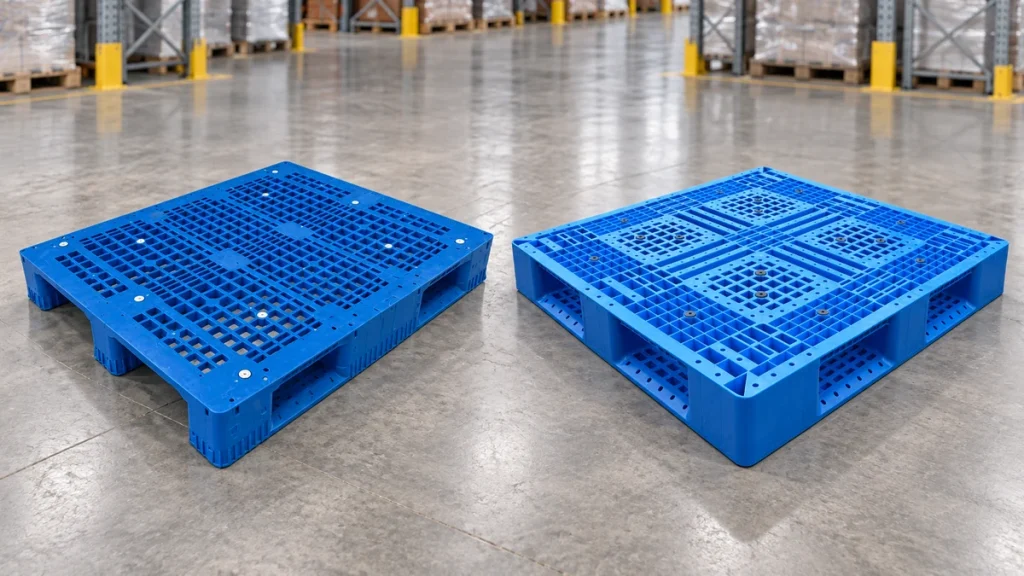
The base of a plastic pallet affects how it meets the floor, rack beams and handling equipment. Two common structures are three-runner and six-runner pallets. They can look similar from above, yet the underside geometry is different. That difference matters when a buyer reviews support points, forklift access, stacking and storage conditions.
This guide explains how to compare the two structures without assuming that every model has the same capacity or material. For exact dimensions, load ratings and reinforcement details, always check the individual product page and confirm the intended application with the supplier.
What Is a Three-Runner Plastic Pallet?
A three-runner pallet has three parallel runners across the underside. These runners create continuous support lines and leave openings for handling equipment. Zhenghao’s three-runner plastic pallet range includes flat-deck and grid-deck models for different handling and storage requirements.
The runner layout should be checked against the direction of entry, the position of rack beams and any conveyor support points. A runner pattern that works well in one system may not suit another, so the application should be reviewed before choosing a model.
What Is a Six-Runner Plastic Pallet?
A six-runner pallet uses a more connected bottom structure, often described as a full-perimeter base on relevant models. The six-runner plastic pallet category brings together the current options, but dimensions, materials and performance specifications still vary by product.
This base geometry can provide a broader pattern of contact around the underside. It does not, by itself, prove a particular load rating or racking capability. Those claims must come from the tested specification of the selected model.
The Main Structural Difference
The clearest difference is the arrangement of the lower support members. Three-runner pallets use three parallel support lines. Six-runner or full-perimeter designs add connecting sections to create a more enclosed footprint.
Buyers should compare the underside rather than relying only on the top deck. For example, this 1400×1200 assembled three-runner flat-deck pallet shows the parallel runner structure, while this 1400×1200 six-runner full-perimeter grid pallet shows a different base arrangement. These examples illustrate structure, not a universal performance comparison.
Start With the Handling Equipment
Confirm which equipment will move the load: counterbalance forklifts, reach trucks, pallet jacks or another system. Check entry directions, fork spacing, wheel paths and clearance under the pallet. Pallet jack rollers interact with the underside differently from forklift forks, so a model that is easy to lift with a forklift may need a separate check for hand-pallet-truck use.
Do not assume that the words “four-way entry” answer every compatibility question. Entry describes access, while safe operation also depends on the exact opening size, runner geometry and equipment dimensions.
Check Storage and Racking Support
Floor storage, block stacking and racking create different support conditions. For rack use, identify the beam spacing and the direction in which the pallet will sit. Ask whether the selected pallet has a published racking load for that arrangement. Do not transfer a rating from another pallet that has a similar appearance.
If the pallet will be stacked when loaded, review how the feet or runners meet the load below. The product, packaging and load distribution can be as important as the pallet structure.
Review Conveyors and Automated Systems
Conveyors and automated handling systems require consistent support at specific points. Record roller pitch, chain position, guide width, transfer direction and sensor locations. A three-runner layout may align well with one conveyor, while a full-perimeter base may interact differently with rollers or chains.
Compatibility should be confirmed with a drawing or a physical trial whenever the process has tight clearances. The base name alone is not enough to approve a pallet for automation.
Compare Model-Specific Specifications
Once the preferred base structure is clear, compare the specifications of the actual models. The most useful fields normally include external dimensions, pallet weight, material options, static load, dynamic load, racking load, reinforcement configuration and operating environment. The plastic pallets category is the starting point for reviewing the wider range.
Dimensions deserve particular attention because similar runner layouts are available in different footprints and heights. Use the plastic pallet sizes guide to organize the dimensional review, then verify the final values on the relevant product page.
When a Three-Runner Pallet May Be the Better Starting Point
Begin with three-runner models when the handling or storage system is already designed around three continuous underside supports. They are also a practical comparison point when a buyer needs clear parallel runner contact and wants to review several deck and size options.
This is a starting point, not a blanket recommendation. The load, rack, conveyor and hygiene requirements still determine whether a specific model is suitable.
When a Six-Runner Pallet May Be the Better Starting Point
Begin with six-runner or full-perimeter models when the process benefits from a more connected base footprint, or when the existing handling system already uses that structure. Review how the perimeter sections meet the floor, stacked loads and transfer equipment.
Again, the structure name does not replace product-level evidence. Confirm capacity, material and reinforcement options for the exact pallet under consideration.
A Practical Buying Checklist
Before requesting a quotation, provide the load weight and distribution, product dimensions, storage method, rack or conveyor details, forklift and pallet-jack types, entry direction, stacking plan, operating temperature, cleaning requirements and expected shipment route. Photos or drawings of the current system can reduce uncertainty.
If you are deciding between these two base structures, contact Zhenghao with the application details. The goal is to match a real pallet model to the handling process, rather than choosing only from a structural label.