
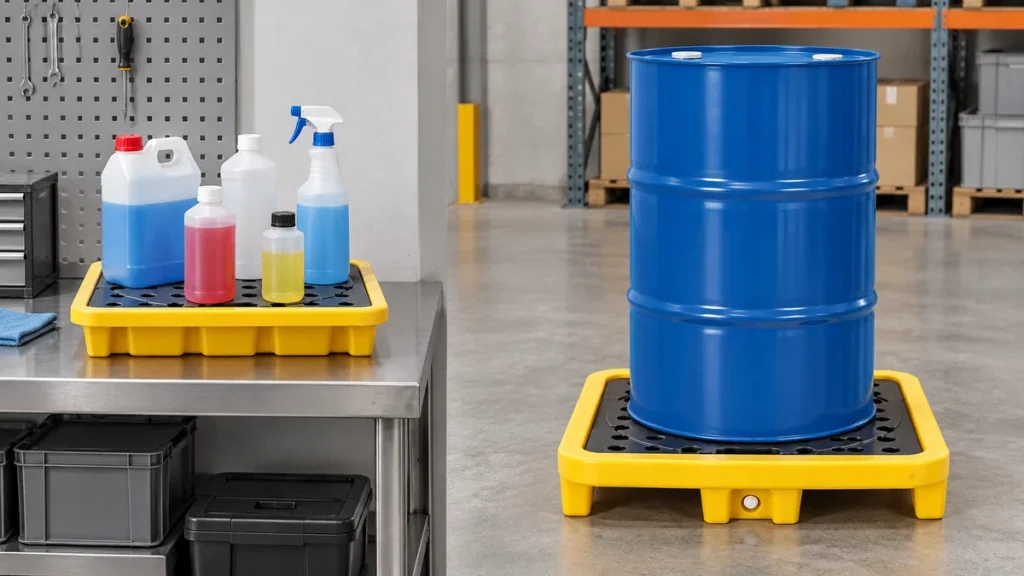
A drum spill pallet and a smaller spill tray both collect leaks, but they are designed for different storage positions. The right choice starts with the containers you need to place on the unit, not with the product name alone. A buyer should compare container size, available floor or bench space, required containment volume, access for inspection, and the way the unit will be cleaned.
Start with the container, not the label
A drum spill pallet is intended for drum or barrel storage. Zhenghao’s current range includes single-drum and multi-drum arrangements. These products sit on the floor and provide a contained base beneath the stored drums.
A tabletop spill tray is a compact option for bottles, cans, small containers, and limited liquid-handling areas. It may sit on a workbench, shelf, cabinet base, or another stable surface. It should not be treated as a smaller version of every drum pallet. The container scale and installation position are different.
Compare the available space
Measure the area before choosing a model. For a floor-based drum pallet, record the drum diameter, the number of drums, the spacing needed for loading, and the route used to reach the storage point. Check doors, aisles, posts, and nearby equipment as well as the open floor area.
For a spill tray, measure the usable bench, shelf, or cabinet surface. The tray must fit without extending into a walkway or blocking normal work. Also confirm that the containers can stand fully inside the usable containment area. A narrow tray may fit the bench but still be unsuitable if the bottles or cans sit too close to its edge.
Check containment volume for the selected model
Containment volume is model-specific. Do not estimate it from the outside dimensions or the number of containers shown in a photograph. Open the individual product page and confirm the stated sump or containment volume. Then compare that figure with the stored liquid, the number of containers, and the rules that apply at the site.
Requirements differ by location and application, so neither a general category page nor a Blog article can confirm legal compliance for a project. Buyers should provide any required containment threshold when requesting a quotation.
Plan inspection and liquid removal
The collected area needs to remain visible and accessible. Before ordering a drum pallet, check how workers will inspect beneath the grating and how collected liquid will be removed. Grating and drain arrangements vary by model. Do not assume that every product has the same configuration.
A compact tray may be easier to lift or clean when empty, but its location still matters. A tray placed at the back of a deep shelf can be hard to inspect. Leave enough room to remove the containers safely and examine the tray without tipping it.
Match the material to the stored liquid
Material must be checked against the actual liquid and operating conditions. Zhenghao’s 490 × 355 × 95 mm compact containment tray lists PP or HDPE material options. A representative single-drum spill pallet lists HDPE. These examples do not make either material universally suitable for every chemical.
Send the supplier the liquid name, concentration, temperature, exposure pattern, and cleaning method. If compatibility is uncertain, request a model-specific review before use.
Think about handling after installation
A product that fits the storage area may still be awkward to handle. For floor-based units, confirm the intended lifting equipment, entry direction, and whether the pallet will be moved only when empty. Do not infer safe loaded movement from fork openings alone.
For tabletop trays, consider how often containers are exchanged and whether staff can reach them without stretching across the containment area. The tray should support the normal task rather than create an obstacle around the work surface.
Use a short purchasing checklist
Before comparing models in the full spill containment range, prepare the following information:
- Container type, dimensions, quantity, and stored liquid.
- Required containment volume and any site-specific rule.
- Available floor, bench, shelf, or cabinet space.
- Inspection, drainage, cleaning, and liquid-removal method.
- Handling equipment and whether the unit must be moved.
- Required material, color, order quantity, and destination.
This brief helps separate a compact tray application from a drum-storage application before model selection begins. For ongoing care after installation, read how to inspect and clean a drum spill pallet.
Common questions from buyers
Can a tabletop spill tray hold a drum?
Do not decide from appearance alone. The selected unit must be designed for the container, weight, footprint, and required containment volume. A compact tabletop model is intended for smaller containers and limited work areas. Use a verified drum pallet for drum storage.
Is a drain required?
That depends on the site procedure and the selected product. Some drum pallet models list a drain or removable grating, while configurations vary across the range. Confirm how collected liquid will be controlled before choosing this option. Never open a drain without an approved collection procedure.
Can the same unit be used for every liquid?
No general material claim can answer that question. Compatibility depends on the liquid, concentration, temperature, exposure time, and cleaning conditions. Provide those details for review and keep the final compatibility decision tied to the selected material and model.
Request the correct containment option
Choose a tabletop tray when the application involves smaller containers on a bench, shelf, or cabinet. Choose a drum spill pallet when the storage position uses drums or barrels on a floor-based containment unit. The final model still depends on its published dimensions, containment volume, material, grating, drain, and handling details.
Request a containment product recommendation and include the container details, stored liquid, available space, and order quantity.