
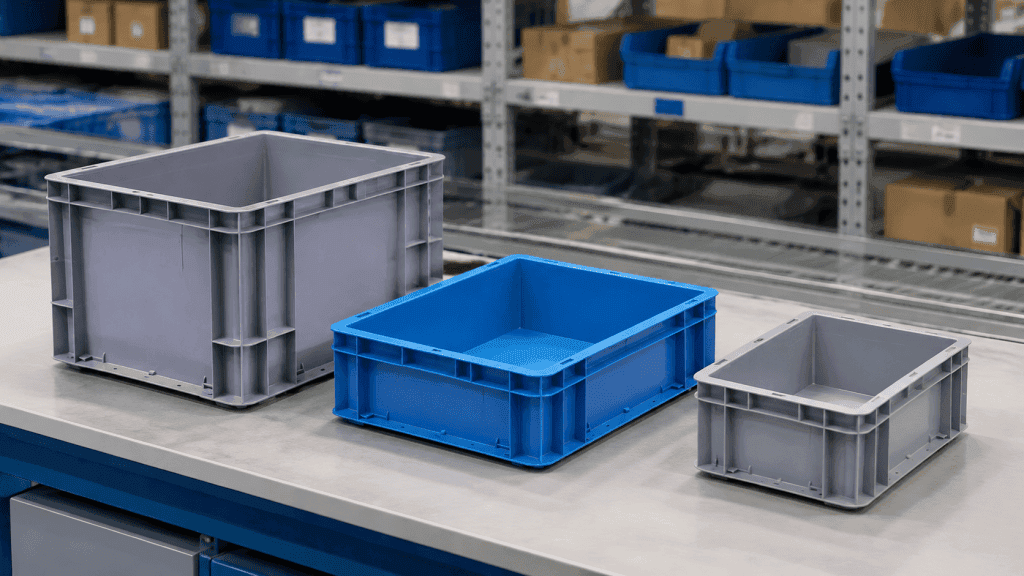
EU plastic boxes are useful when a warehouse needs repeatable container footprints for picking, parts storage and internal transport. The outside size is only the starting point. Buyers also need to compare usable internal space, loaded weight, stacking height and the equipment that will handle the box.
This guide explains how to prepare a practical specification before comparing Zhenghao’s EU plastic boxes. The current range uses new PP material and includes three stackable models with different external heights and footprints.
Start with the item, not the box catalogue
Measure the parts, tools or packaged goods that will go into the box. Record the longest item, the space needed between items and the quantity required per container. Internal dimensions matter here. A box with the correct outside footprint may still be too small once its wall thickness and internal taper are considered.
Also record the total loaded weight. The product weight alone does not show whether the box is suitable for the planned load or stacking arrangement. Buyers should give the supplier the item weight, quantity per box and expected stack height so the selected model can be checked against the real handling condition.
Compare the footprint and height separately
A compact footprint can help organize small parts, while a larger footprint may reduce the number of boxes needed for bulkier components. Height changes capacity, reach and stack planning. It should not be treated as an automatic upgrade.
Zhenghao currently lists a 300 × 200 × 120 mm PP EU box with internal dimensions of 265 × 165 × 110 mm. Its published weight is 0.5 kg ±3%. This compact format can suit small components and line-side supply where the item dimensions fit the usable space.
Two current models use a 400 × 300 mm footprint. The 400 × 300 × 120 mm plastic Euro box has published internal dimensions of 370 × 270 × 114 mm and a weight of 0.8 kg ±3%. The taller 400 × 300 × 260 mm industrial storage box has internal dimensions of 370 × 270 × 250 mm and a published weight of 1.45 kg ±3%.
These figures show why the full three-dimensional specification matters. The two 400 × 300 mm boxes share the same nominal footprint but serve different volume and height requirements. Buyers should use the product page and drawing for the selected model rather than transferring one model’s internal dimensions to another.
Plan the picking method
For manual picking, check how the operator reaches the contents. A deeper box may hold more, but it can make small items harder to see or retrieve. A shallower box may be easier for frequent picking and line-side replenishment. Item presentation, pick frequency and working height should guide the choice.
If boxes move between shelving, carts, workstations or conveyors, record the available clearances at each point. Confirm the external dimensions against shelf openings, guide rails, stops and transfer points. Equipment compatibility should be checked for the actual system. A familiar footprint does not replace an interface review.
Check stacking under real operating conditions
All three current models are described as stackable. Buyers still need to define what stacking means in their operation. A short stack of lightly loaded boxes at a workstation is different from a taller stack kept in storage or moved through a warehouse.
Provide the expected loaded weight per box, number of boxes in a stack, storage duration and floor or shelf conditions. If stacks will be moved, describe the handling equipment and route. The supplier can then review the selected model for that use rather than relying on a general stackable description.
Decide what information the box must carry
Warehouse boxes often support part identification as well as storage. List any label, barcode or color-separation requirement in the enquiry. Confirm where the label must sit and whether it needs to remain readable when boxes are stacked.
Color can help separate product families, production stages or handling zones, but availability should be confirmed for the order quantity. If the project needs lids, special handles or other options, ask about the exact model. Do not assume that an option shown on one box is available on every size.
Include cleaning and return handling in the brief
Describe the expected dirt, dust, oil or process residue, along with the site’s cleaning method. The box shape, internal corners and frequency of cleaning affect day-to-day use. If empty boxes return through the same logistics loop, include the return route and available storage space.
The current EU boxes are stackable. They should not be described as nestable unless the selected product is specifically confirmed for nesting. This distinction matters because stacking supports loaded storage, while nesting is intended to reduce empty return volume.
Prepare a quotation checklist
A useful request should include:
- Item dimensions, quantity per box and total loaded weight.
- Required external footprint and usable internal dimensions.
- Expected stack height and whether loaded stacks will be moved.
- Shelf, cart, workstation, conveyor or other equipment interfaces.
- Color, labeling and model-specific accessory requirements.
- Cleaning method, order quantity and destination.
With this information, buyers can compare the three current sizes without treating every EU box as interchangeable. For other container structures, browse the full plastic crates range. For a model recommendation or quotation, send Zhenghao the handling brief.