
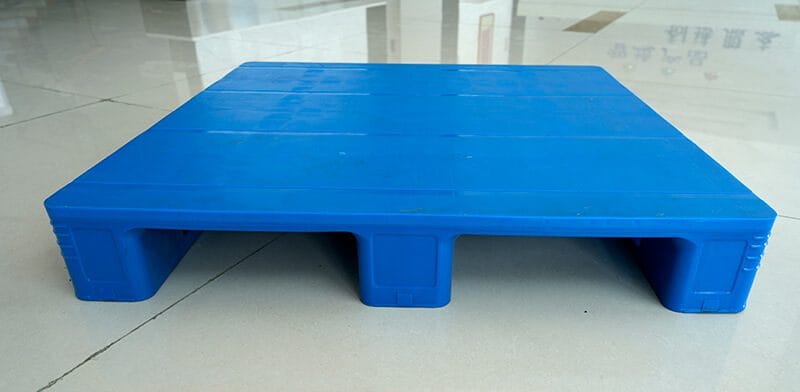
A pallet that works in a general warehouse is not automatically the right pallet for food or beverage handling. The choice depends on the packaged goods, cleaning routine, storage temperature, handling equipment and actual load condition. Buyers should compare those requirements with a specific pallet model instead of relying on a broad label such as “food pallet.”
This guide explains the questions to settle before ordering plastic pallets for bottled drinks, packaged food, ingredients and warehouse distribution.
Start with the goods and the handling route
Write down what the pallet will carry and where it will travel. Bottled water, cartons, cans, bags and packaged ingredients place different demands on the deck. A pallet used only for floor storage also faces a different load condition from one used on racks, conveyors or automated equipment.
The basic project record should include the unit load dimensions, maximum loaded weight, pallet footprint, storage method and handling equipment. If the pallet moves through cold rooms, wet areas or regular wash cycles, include those conditions as well.
Choose the deck around support and cleaning
A flat deck gives cartons, bags and other packaged goods a continuous support surface. Its suitability still depends on the deck construction, surface finish and cleaning process. A grid deck can reduce pallet weight and allow airflow or drainage, but openings must suit the goods and the facility’s hygiene procedure.
Do not choose between flat and grid decks by appearance alone. Check whether small cartons, flexible bags or shrink-wrapped bottles need more surface support. Ask how residue will be removed and whether water can drain after washing. Anti-slip features may help with load stability, but their position and form vary by model.
Separate static, dynamic and racking loads
Load ratings describe different operating conditions. Static load applies when the pallet rests on a level floor. Dynamic load covers movement by suitable handling equipment. Racking load applies when the pallet is supported on a rack, and it depends on the support direction, span, reinforcement and load distribution.
One number cannot replace the other two. Send the actual load pattern and handling method when requesting a recommendation. If racking is involved, provide the rack support layout rather than assuming that every heavy-duty pallet is rackable.
Match the bottom structure to the equipment
Three-runner pallets are often considered for forklift handling, storage and some racking projects. Six-runner or full-perimeter bases provide broader bottom support for selected warehouse and stacking conditions. Double-sided pallets may suit applications that need a reversible structure, while nestable pallets can reduce empty-pallet volume in some export or return plans.
These are structural categories, not universal performance guarantees. Forklift entry, pallet-jack access, conveyor contact and racking suitability must be checked on the exact model. A pallet that fits one part of the route may not fit the next.
Confirm material and temperature requirements
PP and HDPE can both be available for plastic pallets, depending on the model and order. The final choice should reflect the operating temperature, impact conditions, cleaning chemicals and expected reuse cycle. Cold storage deserves particular attention because material behavior can change at low temperatures.
If the facility requires food-contact documents, a defined resin grade, color control or another product-specific record, state that requirement before ordering. Do not assume that a pallet’s color or smooth deck proves a particular approval.
Review pallets for bottled water and beverage handling
Zhenghao’s Bottled Water Plastic Pallets category is the commercial page for the current beverage-focused range. It contains three products with different structures. Open the individual pages to review the available information and confirm the selected configuration:
- Heavy-duty bottled water plastic pallet for beverage storage and transport
- Heavy-duty plastic pallet for water bottles
- Industrial stackable beverage plastic pallet
For other deck and bottom structures, browse the full Plastic Pallets category. The category pages show what is available; this article helps prepare the information needed to compare those options.
Buyer checklist before requesting a quotation
- Goods and packaging type
- Unit load dimensions and maximum loaded weight
- Required pallet footprint
- Floor storage, stacking, racking or conveyor use
- Forklift and pallet-jack entry requirements
- Cleaning method, moisture and drainage conditions
- Operating and cold-storage temperature
- Required material, color, marking and documentation
- Order quantity and destination
This checklist helps separate model facts from assumptions. It also makes it easier to identify where a project needs further technical confirmation.
Common questions
Are plastic pallets suitable for food and beverage logistics?
Plastic pallets are used for packaged food, bottled products and beverage distribution. Suitability depends on the exact pallet, the goods, the facility’s cleaning rules and any documentation required for the project.
Is a flat deck always the best choice?
No. A flat deck provides a continuous support surface, while a grid deck may offer drainage, airflow or lower pallet weight. The better option depends on the package, cleaning process and handling route.
Can the same load rating be used for floor storage and racking?
No. Static, dynamic and racking ratings describe different conditions. Confirm the relevant rating and the way the load is supported for the selected model.
What should an overseas buyer send with an inquiry?
Send the pallet size, goods, maximum loaded weight, storage method, handling equipment, cleaning conditions, temperature, required quantity and destination. Include any documentation or customization that must be reviewed.
Request a food and beverage pallet recommendation after collecting the project details.