
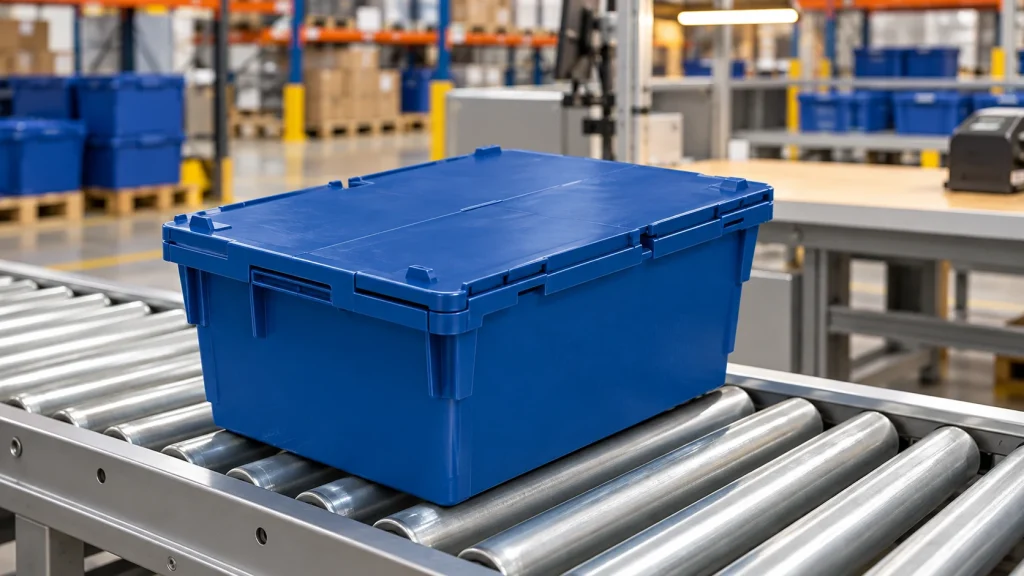
Attached lid containers are often selected for repeat movement between warehouses, stores, service points and production areas. The container is only one part of the system. The return route, handling points, contents and empty-container plan all need to be clear before a buyer asks for a recommendation.
This guide helps buyers prepare an enquiry for Zhenghao’s Attached Lid Containers. The category is for comparing current products. The checklist below focuses on the operating information needed to compare a specific model.
Map the forward and return journey
Start with the full route. State where containers are packed, where they are opened, where they are emptied and how they return. A tote used only between two fixed sites can be planned differently from one that passes through several stores or service locations.
Include the number of handling points and the expected turnaround time. This helps the supplier understand whether the project is a simple one-way movement, a closed return loop or a mixed distribution process.
Describe the contents and packing pattern
Explain what goes inside the container, including the product dimensions, packed weight, quantity per tote and any internal dividers, bags or liners. Useful internal space depends on the actual pack pattern, not only the outside footprint of a box.
Provide photographs or a simple packing sketch when the goods have an unusual shape. The selected product page should be used to confirm the exact internal and external dimensions for the proposed model.
Check how the lid is used
Describe when the lid is opened and closed. State whether users pack the tote at a bench, pick from it during a route, stack it while closed or return it empty after delivery. An attached lid can help keep the lid with the container, but the practical opening and closing routine still needs to fit the work process.
Do not assume the same lid arrangement applies to every model. Confirm the details of the selected product before placing an order.
Also note whether the lid must stay closed during a particular transfer or whether staff need frequent access to the contents. That simple detail can affect the preferred container layout and the way a site plans its picking routine.
Plan loaded storage and empty return
Loaded storage and empty return often have different space limits. Record the available shelf, vehicle or staging space for the loaded tote. Then describe how the empty containers are collected and stored. This is especially important when a return programme covers many locations.
The buyer should also state whether empty containers are sent back in the same vehicle, collected on a separate schedule or held at the destination. A clear return plan makes the product comparison more useful.
List the actual handling equipment
State how workers and equipment move the containers. Include manual handling, carts, conveyor sections, picking stations, delivery vehicles and storage locations where relevant. The route matters more than a generic claim about compatibility.
For a current model route, see the Attached Lid Container Stackable Plastic Storage Box. Check its live product page, then ask for confirmation against the actual handling process.
Set the cleaning and ownership routine
Say who owns the containers, who cleans them and where that work happens. A returnable system needs a practical method for tracking, cleaning and returning units. If containers move between companies, explain how they are identified and how shortages are reported.
These are project rules rather than universal product features. Sharing them early keeps the quotation discussion focused on the real operating model.
Where containers circulate between several teams, name the person or department that can confirm the return process. A quotation can then be reviewed against the route that will actually be used, rather than against an assumed workflow.
Define colour and identification needs
Many return systems use colour, labels or other identification to separate routes, product groups or owners. Provide the requested colours, identification wording and artwork requirements with the enquiry. Ask which options can be confirmed for the selected model and order quantity.
Identification helps a site run its own process. It does not replace inventory control, staff training or the buyer’s local collection procedures.
Prepare a concise quotation brief
A useful enquiry includes the contents, pack pattern, forward route, return route, handling equipment, storage conditions, cleaning routine, requested colours, quantity, destination and preferred delivery date. This lets the supplier compare relevant models without relying on a generic description.
For other reusable container structures, review Plastic Crates. If the goods need a larger bulk-handling unit, the separate Pallet Boxes category is a better starting point.
Use this checklist before you enquire
- Contents, pack pattern and approximate packed weight
- Forward route, opening points and return route
- Loaded storage and empty-container space
- Handling equipment and transfer points
- Cleaning, ownership and identification process
- Colours, quantity, destination and delivery timing
Where to go next
Review the available Attached Lid Containers and open the product pages that fit the preliminary route. When the checklist is ready, send Zhenghao an enquiry for model-specific confirmation.